Chapter 8: Functions III: Mappings and Inverses
Chapter 4 introduced functions, their representations, and several basic function classes, while Chapter 5 showed how functions can be combined and composed. We now study how functions map their domains to their codomains, when those mappings can be reversed, and how inverse relationships can be used to solve non-linear equations. We conclude by determining whether a relation defines a function.
Injective, Surjective, and Bijective Functions
Functions can also be classified based on how they relate elements of their domain to elements of their codomain. While algebraic form determines a function’s shape or formula, mapping properties determine whether the function is injective, surjective, or both.
A function is injective (or one-to-one) if it never assigns the same output value to two different inputs. In other words, each output in comes from at most one input in .
More formally, we can write:
Or in plain words: If two inputs of a function give the same output, then those inputs must be equal.
The figure contrasts a function where each output comes from at most one input with one where two inputs share an output.
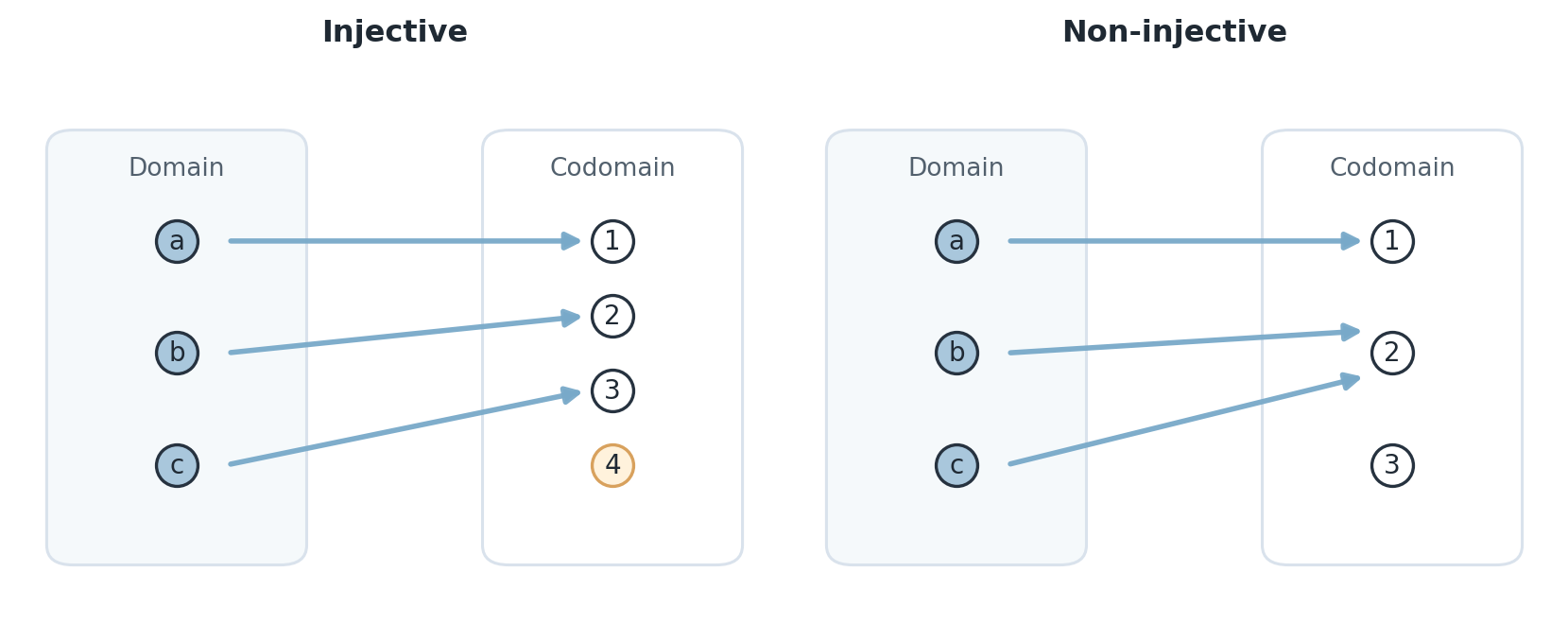
Let be defined by:
This function is injective because different -values always produce different -values. However, is not injective on since .
A function is surjective (or onto) if every element of the codomain appears as an output of the function. Equivalently,
More formally, we can write:
Or in plain words: For every possible output value in the codomain, there exists at least one input value in the domain that produces it.
Surjectivity is about whether the function reaches every output in the codomain; the figure compares a function that covers the codomain with one that leaves gaps.
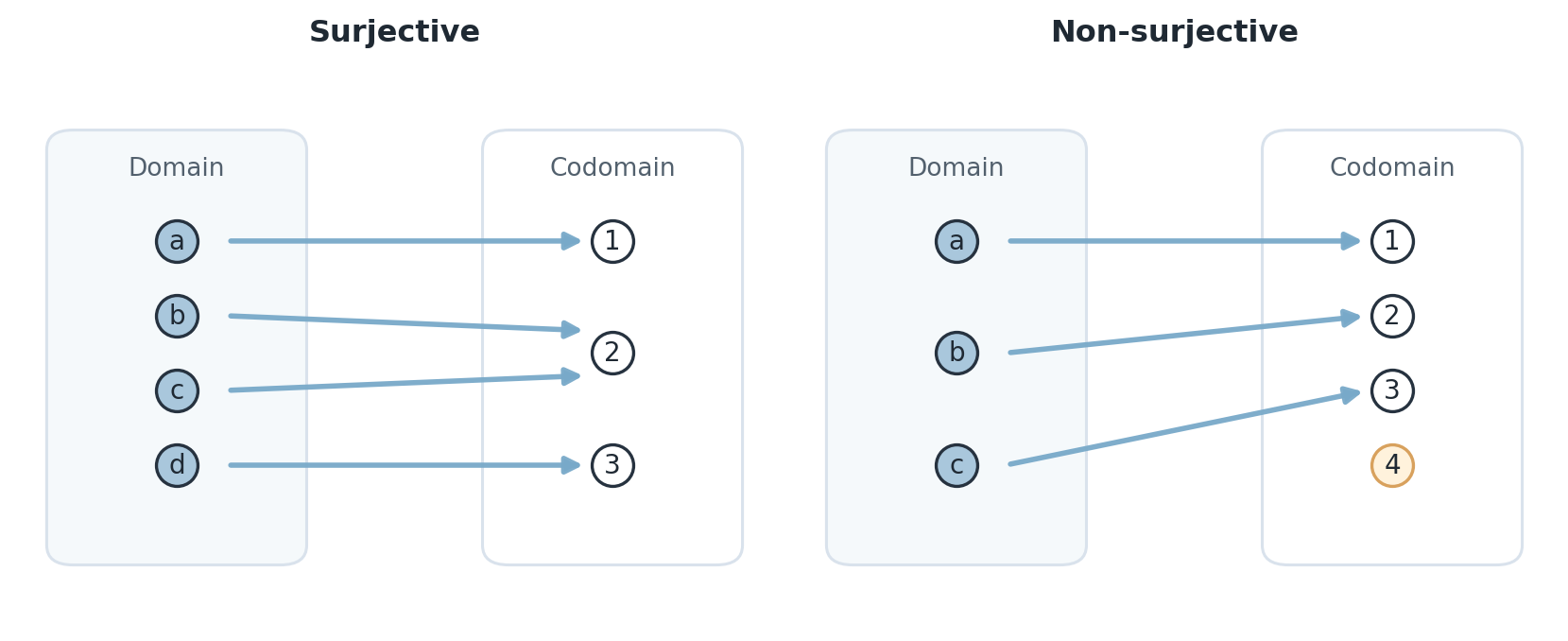
Let be defined by:
For any , there exists , so is surjective. However, from is not surjective because negative -values are never reached.
A function is bijective if it is both injective and surjective. This means that distinct inputs have distinct outputs, and every element of is produced by an input from .
Equivalently, a bijective function establishes a one-to-one correspondence between the sets and , so that nothing is repeated and nothing is left out.
A bijective function combines both requirements: no output is repeated, and none are missing.
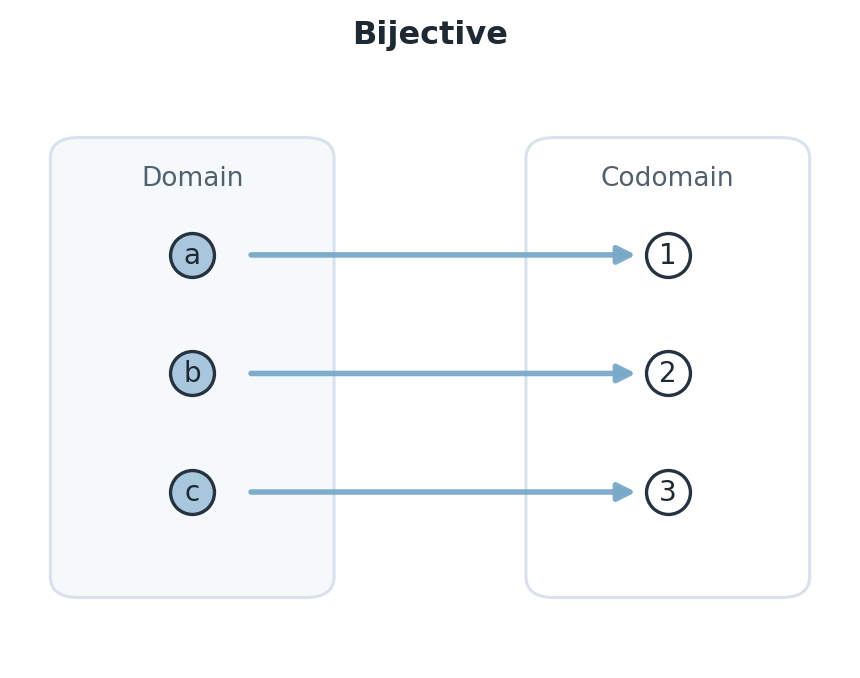
Let be defined by:
The function is bijective because each input produces a unique output (injective) and every real number occurs exactly once as an output (surjective).
Inverse Functions
An inverse function reverses the input-output mapping of a function. It is useful when we know an output and want to recover the input that produced it.
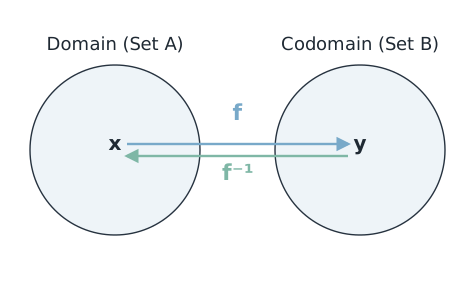
Let be a bijective function. Its inverse satisfies
for all and . Thus, applying followed by , or vice versa, returns the original value.
The inverse allows us to solve by applying :
- A function has an inverse on its stated codomain only if it is bijective. If it is not injective, an output may correspond to several inputs; if it is not surjective, some elements of the codomain cannot be reversed.
- The notation represents the inverse function, not the reciprocal:
For the notation below, means that is applied first and then , while the identity function on a set is defined by . Function composition was introduced in Chapter 5.
The composition of a function and its inverse returns the identity function on the respective domains:
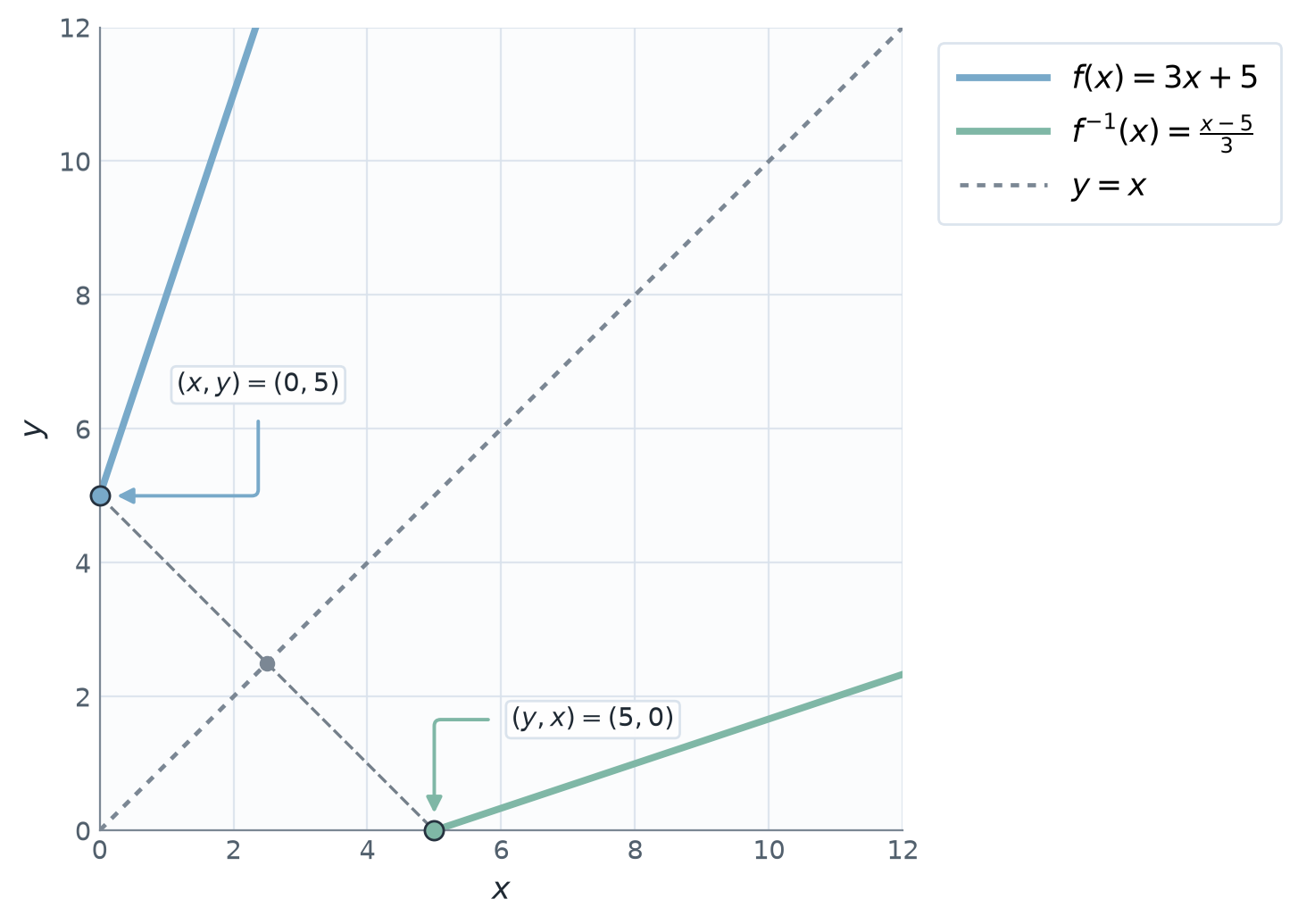
The inverse reverses the domain and codomain of . Graphically, its graph is the reflection of the graph of across the line .
To find an inverse function:
- Write the function as .
- Solve the equation for in terms of .
- Rewrite the result as , or rename the input variable.
- Check that composing the two functions in either order returns the original input.
Let be defined by
To find its inverse, solve for :
Therefore,
For example, gives
We can check the formula in both directions:
and
Common Inverses
The table below shows frequently used inverse-function pairs with the domain and range of the original function. The restrictions shown are part of the function definition and ensure that the mapping is bijective.
Table 8.1. Common inverse-function pairs with domains and ranges.
| Function | Inverse | Domain of | Range of |
|---|---|---|---|
| , | |||
| , | |||
| , a positive odd integer | |||
| , a positive even integer | (principal root) | ||
| , , | |||
| , , | |||
Logarithm Rules
Let , , and . For a logarithm base with , the most important rules are:
Table 8.2. Common logarithm rules.
| Rule | Formula | Description |
|---|---|---|
| Logarithm Product Rule | The logarithm of a product equals the sum of the logarithms. | |
| Logarithm Quotient Rule | The logarithm of a quotient equals the difference of the logarithms. | |
| Logarithm Power Rule | A power in the argument becomes a multiplier in front of the logarithm. | |
| Logarithm of 1 | Any valid base raised to the power equals . | |
| Logarithm of the Base | Any valid base raised to the power equals itself. | |
| Inverse Property | Exponential and logarithmic functions cancel each other. | |
| Natural Log of | The natural logarithm means logarithm to base . | |
| Change of Base | Here and . |
The natural logarithm is , where . These rules mirror the exponent rules introduced in Chapter 3.
Solving Non-Linear Equations
Many equations in mathematics involve non-linear functions such as exponentials and logarithms. The solving principles remain the same: we transform the equation into an equivalent one where the variable of interest is isolated, checking that the solution satisfies any domain restrictions.
With inverse-function pairs and logarithm rules now established, we can use them to undo the operation affecting the variable. In particular, when the variable appears in an exponent, we apply a logarithm to both sides, and when it appears inside a logarithm, we apply an exponential.
Solve the equation for . Assume that , as the logarithm otherwise is not defined. We obtain:
Both candidates satisfy the domain restriction because , so both are solutions of the original equation.
Testing Relations
To check whether a relation describes as a function of :
- For a list of ordered pairs, check that each input has only one associated output .
- Graphically, use the vertical line test: each vertical line should intersect the graph at most once.
- Algebraically, try to solve for in terms of . If one input can produce more than one output, the relation is not a function of .
Graphically
A relation in which each -coordinate is matched with exactly one -coordinate describes as a function of . If the same -coordinate is associated with two different -coordinates, then the relation is not a function of .
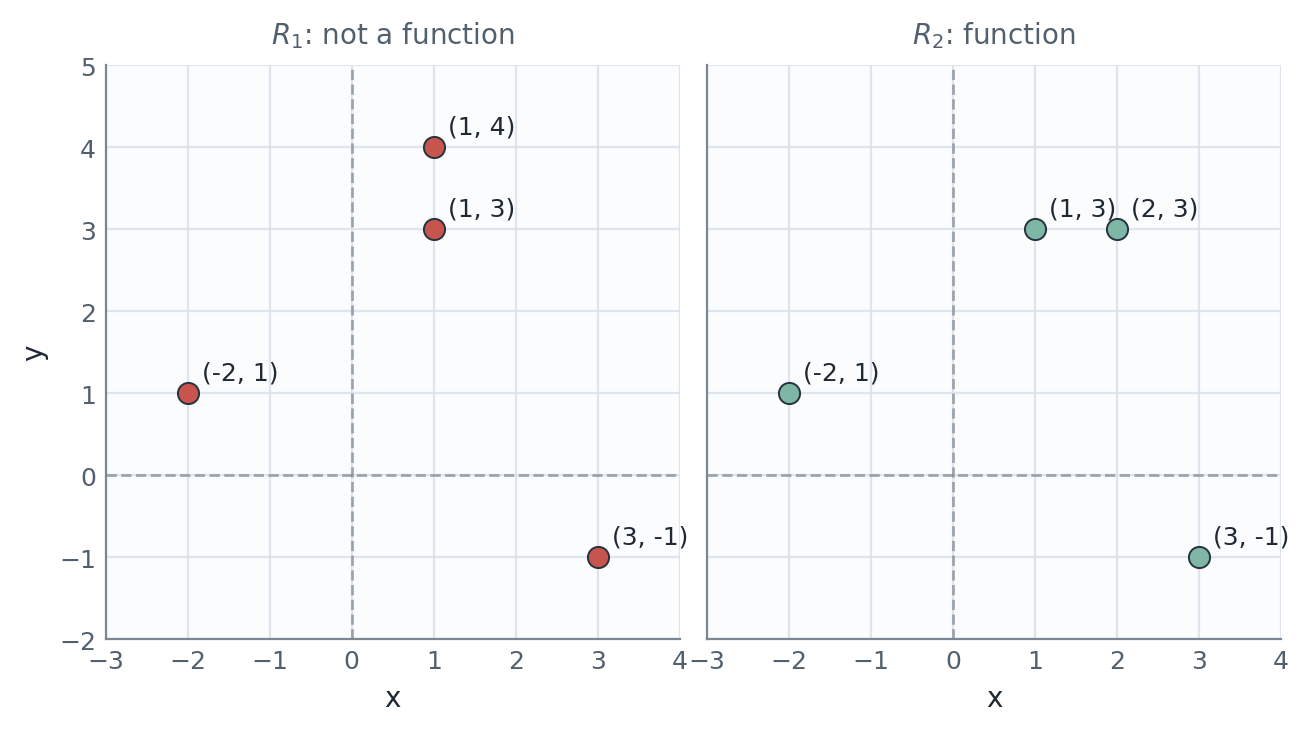
Which of the following relations describe as a function of ?
In , the input is matched with both and . Hence, does not describe as a function of . In , every input has exactly one corresponding output, so does describe as a function of .
The Vertical Line Test
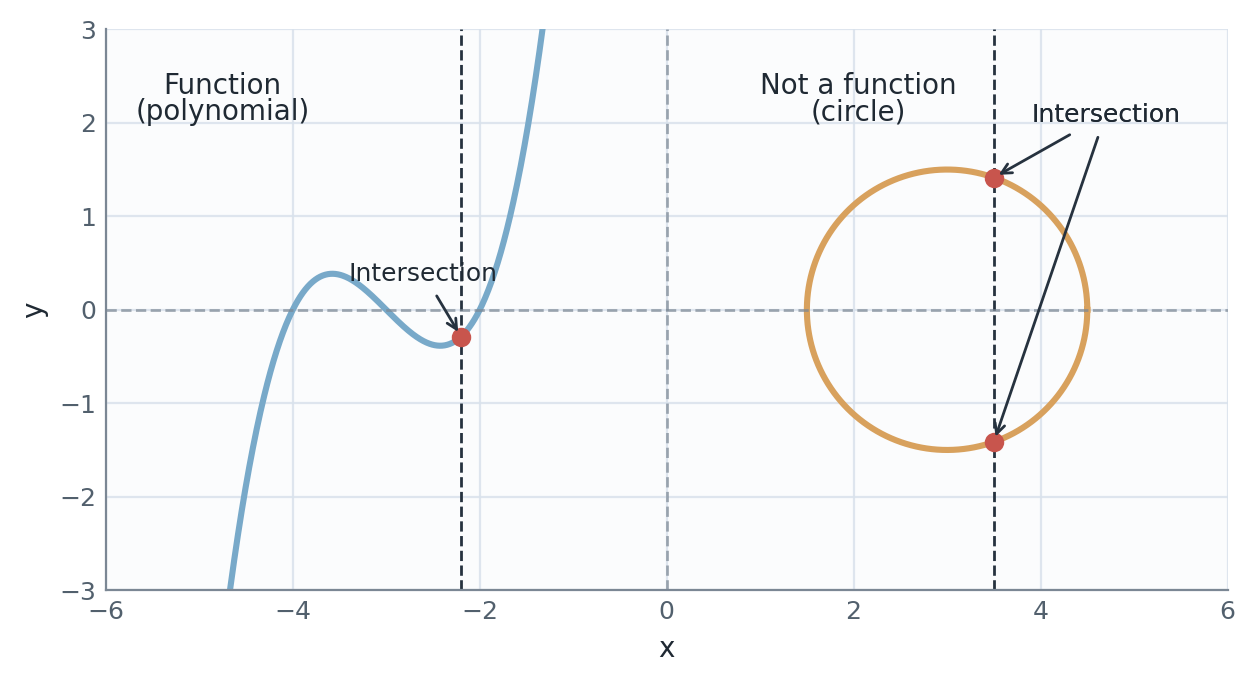
A relation describes as a function of if and only if every vertical line intersects its graph at most once.
If a vertical line intersects the graph more than once, the relation assigns more than one output to the same input and therefore violates the definition of a function.
An equation can describe a valid relation, such as a circle, without defining as a function of . Such relations may require another representation, for example an implicit or parametric description.
Algebraically
We can also check whether an equation defines a function by solving for one variable in terms of the other. If solving produces more than one output value for the same input, then the relation does not describe a single function.
Does the equation represent as a function of ?
First, solve for :
For inputs with , this gives two outputs, one positive and one negative. Therefore, the circle does not describe as a single function of . The upper and lower semicircles can instead be described separately by and , each with domain .