Chapter 9: Limits
Limits describe the behavior of functions near a point and provide the foundation for continuity and differentiation. This chapter introduces limits, uses them to define continuity and discontinuity, and then presents the main limit laws used in calculations.
Limits
The concept of a limit concerns the value that a function approaches as its input gets closer to a particular point. Importantly, what happens exactly at that point is not what matters, instead, we focus on what happens around the point.
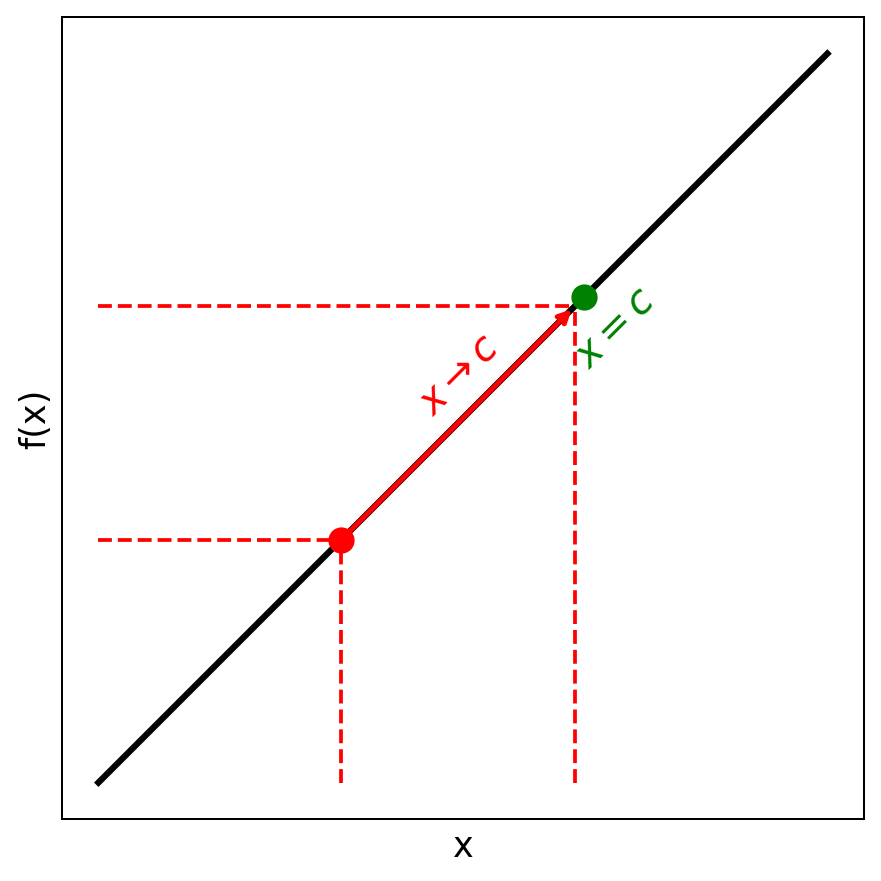
Understanding the concept of a limit is fundamental as it allows us to study the continuity of functions, a property describing whether a function behaves smoothly without abrupt jumps or breaks. Furthermore, limits provide the foundation for the derivatives introduced in Chapter 10, which describe rates of change.
To illustrate this and build an intuitive understanding of the concept of limit, consider the function and its corresponding graph:
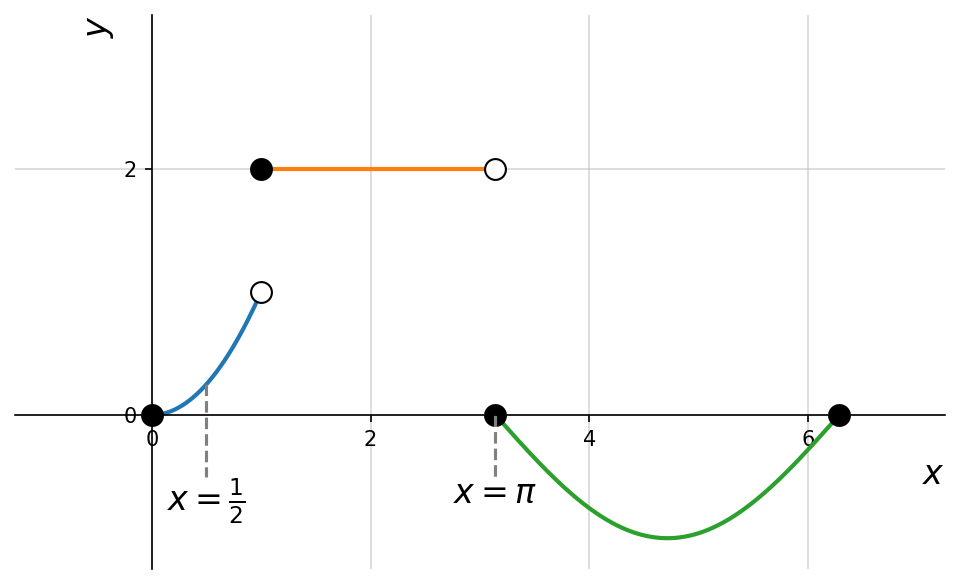
Let us consider the limit of as . This means that we look at values of for in some small interval around . In this case, this corresponds to examining the function on the interval . If we look the graph of this function, we can see that as approaches from either the left or the right, the value of approaches .
Therefore, the limit of as can be expressed symbolically as:
This example illustrates the basic idea behind limits. We now state this idea in more general terms.
Let be a function defined on an open interval containing (with the possible exception of itself). Let be a real number. If all values of the function approach the real number as the values of approach the number , then we say that the limit of as approaches is .
In words, as gets closer to , gets closer and stays close to . Symbolically, we express this idea as
if and only if
Here means approaching from the right (positive direction) and means approaching from the left (negative direction).
Not every function has a limit at every point. A limit may fail to exist for several reasons. To illustrate this, we return to our earlier example and now consider and . At each of these points, the left-hand and right-hand limits differ:
Since these one-sided limits are not equal, does not exist. The same reasoning applies at .
Another way a finite limit can fail to exist is if the function grows without bound. For example,
As increases, grows without bound. We express this behavior using the extended notation
Here describes the input becoming arbitrarily large, while the symbol on the right describes the output growing without bound. The symbol is not a real number, so this does not represent a finite limit.
Limits at Infinity and Infinite Limits
The notation
means that approaches the finite value as becomes arbitrarily large. For example,
By contrast, writing means that the outputs grow without bound as approaches the finite number . One-sided behavior still matters. For example,
Because these one-sided behaviors do not agree, the two-sided limit does not exist.
Continuity
The discussion about when limits exist and do not exist leads to the concept of continuity. A continuous function has no jump, gap, or mismatch between the value approached by the function and the value the function actually takes.
Let be a function, where is the domain of .
At an interior point of , the function is said to be continuous at if
That is, as approaches , the value of approaches the same number that actually takes at .
If is an endpoint of the domain, continuity is defined using the one-sided limit from within the domain. For example, at a left endpoint , continuity means
At an interior point, we can break this definition into its essential parts:
-
The limit exists: The left-hand and right-hand limits of at are equal. In symbols,
This ensures that approaches a single, well-defined value near .
-
The function value is defined: The point exists, meaning that belongs to the domain . Without a defined value at , the concept of continuity cannot apply.
-
The limit equals the function value: The value that approaches near is exactly the same as the value it takes at :
This guarantees there is no jump or gap in the function’s behavior at that point.
If is continuous at every point , then we say that is continuous on .
Continuity can therefore be viewed as a local property at each point, which extends to a global property when it holds throughout the entire domain.
In practice, most functions we encounter (such as polynomial, exponential, logarithmic, and trigonometric functions) are continuous on the domains we care about.
Consider the function
We want to determine whether is continuous at .
-
The limit exists:
Since both one-sided limits are equal, the limit exists and equals 2. The condition is satisfied.
-
The function value is defined:
The function has a defined value at . The condition is satisfied.
-
The limit equals the function value:
The limit and the function value are not equal. The condition is not satisfied.
Since the third condition fails, is not continuous at .
Discontinuity
Continuity gives us a precise way to describe when a function behaves smoothly at a point. A discontinuity occurs when at least one part of the continuity definition fails.
A function is discontinuous at a point if it is not continuous at .
This can happen if:
- the two-sided limit does not exist,
- the function value is not defined, or
- the limit exists but does not equal the function value.
Consider the function from the earlier limit example, where has jumps at and .
At , the one-sided limits are different:
Because the left-hand and right-hand limits do not agree, the two-sided limit does not exist. Therefore, has a jump discontinuity at .
Discontinuity does not always mean that the limit fails to exist. Sometimes the limit exists, but the function value is different.
Here is an example where the graph approaches one value, but the function is defined to take another value at the point.
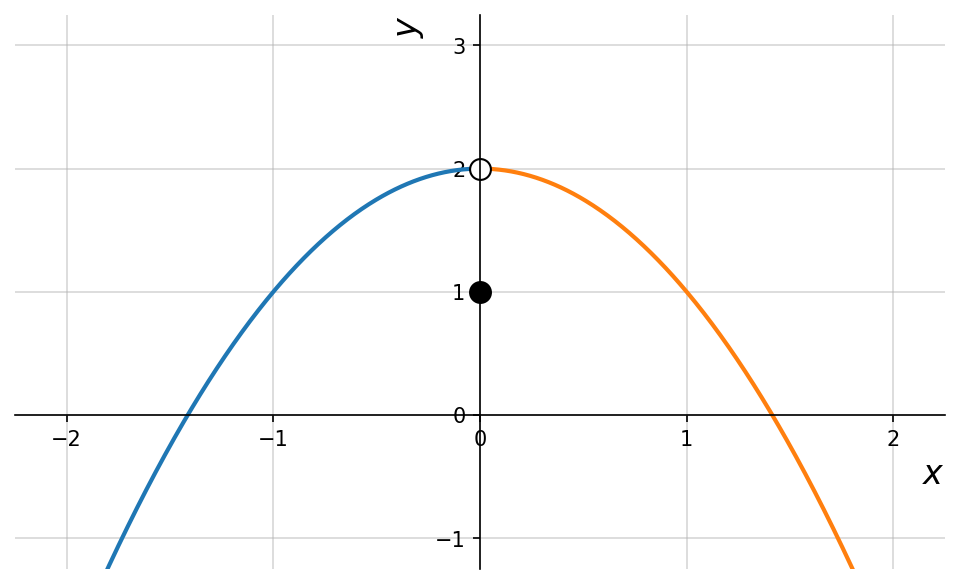
Looking at the graph, it is clear that despite , the actual function value is . Since the limit and function value are not equal, is discontinuous at .
Limit Laws
In Chapter 5, arithmetic operations were used to combine two functions. The table below shows the corresponding rules for limits, assuming both and exist.
The following rules allow us to compute limits of combined functions from the limits of the individual functions.
Table 9.1. Limit laws for combining functions.
| Operation | Limit Law |
|---|---|
| Constant Multiple | |
| Sum/Difference | |
| Product | |
| Quotient |
If is continuous at , then
Thus, direct substitution can be used for polynomials and for rational, root, exponential, logarithmic, and trigonometric expressions at points where the expression is defined and continuous.
This calculation shows how the limit laws let us split a combined expression into simpler parts.
Determine
- Split into two limits (use the difference law):
- Evaluate each part directly (direct substitution):
Sometimes direct substitution produces an indeterminate form; then algebraic simplification can reveal the limit.
Determine
- Check direct substitution (does not work!):
- Factor numerator and cancel the common factor. For , the fraction simplifies to . Although the original function is not defined at , the limit only concerns nearby values with :
- Evaluate the expression (direct substitution):