Chapter 3: Basic Algebra
This chapter revisits some fundamental algebraic rules involving signs, fractions, exponents, and the use of parentheses. Having a good grasp of these rules is essential, since many common mistakes in computation and symbolic manipulation arise from misunderstanding or misapplying these basic principles.
Unless otherwise specified, all constants and variables are assumed to be real numbers, i.e., elements of .
In other words, standard operations such as addition, subtraction, multiplication, and division (except division by zero) produce results that remain within .
Order of Operations, Signs, and Like Terms
When an expression contains several operations, the order in which they are performed matters.
Evaluate an expression in the following order:
- Parentheses and other grouping symbols, including the numerator and denominator of a fraction.
- Exponents and roots.
- Multiplication and division, working from left to right.
- Addition and subtraction, working from left to right.
When multiplying or dividing two numbers:
-
equal signs give a positive result:
-
different signs give a negative result:
Subtraction can be read as adding the opposite.
Like terms have the same variable part, including the same exponents. They can be collected by adding or subtracting their coefficients.
The terms with variable part can be collected, as can the constant terms:
By contrast, and are not like terms and cannot be combined into one term.
The absolute value is the distance from the real number to . Therefore,
In particular, and for every real number . The symbol denotes the non-negative, or principal, square root of .
Exponentiation is performed before a leading minus sign. Thus,
whereas parentheses make the negative value part of the base:
For example, , while .
Basic Algebraic Properties
Before more advanced algebraic concepts are introduced, it is useful to recall a few basic properties that govern addition and multiplication. These properties, i.e., the commutative, associative, and distributive laws, apply to all real numbers and allow expressions to be manipulated regardless of how they are written or grouped.
These laws describe how addition and multiplication behave when terms are reordered, regrouped, or distributed across parentheses.
Commutative law. The order of two elements does not affect the result:
Associative law. The way elements are grouped does not affect the result:
Distributive law. Multiplication distributes over addition and subtraction. For addition:
This property distributes a factor across the terms inside parentheses.
Consider the expression:
Using the distributive law, is multiplied by each term inside the parentheses:
The result is the same as first adding the terms inside the parentheses and then multiplying:
This confirms that the distributive and associative properties are consistent, i.e., the order in which the factors are grouped or distributed does not change the result.
Consider the expression:
Here, the negative sign in front of the parentheses can be interpreted as multiplying by :
Applying the distributive law multiplies by each term inside the parentheses:
This shows that placing a negative sign in front of parentheses changes the sign of each term inside.
Fractions
Fractions represent parts of a whole and are especially useful when dealing with proportions, ratios, and percentages. A fraction consists of two parts:
- A numerator (top number): represents the number of parts being considered.
- A denominator (bottom number): represents how many equal parts make up the whole.
In symbolic form, a fraction is written as a ratio of two integers:
The set of all such numbers is called the rational numbers and denoted by , and it forms a proper subset of the real numbers:
Adding fractions is not done by simply adding the numerators and denominators:
For example:
but
which is incorrect for addition. A common denominator is required, as explained below.
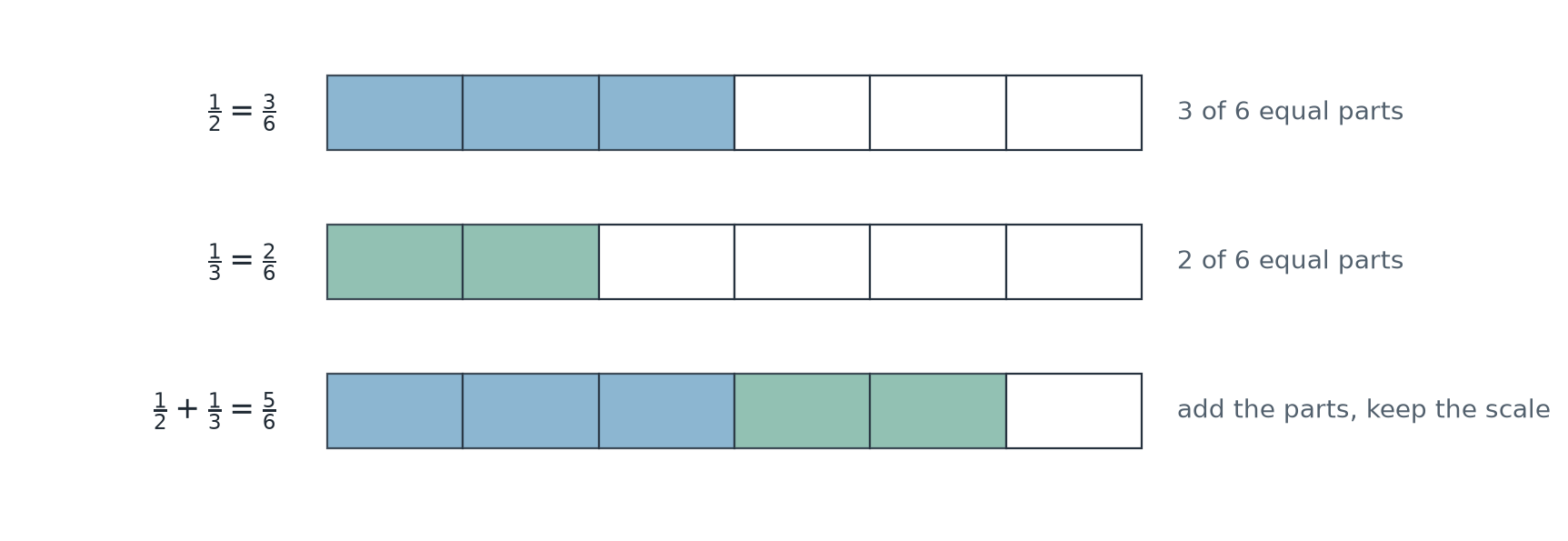
To add or subtract fractions, the denominators must be the same. Once a common denominator is found, the numerators can be added or subtracted while the denominator remains unchanged.
If the denominators are already the same:
If they are different, multiply each numerator by the other fraction’s denominator to obtain a common denominator:
The following examples show the same rule in three common situations: matching denominators, different denominators, and subtraction.
-
Evaluate the following expression (fractions with the same denominator):
-
Evaluate the following expression (fractions with different denominators):
- Evaluate the following expression (subtracting two fractions):
Multiplication of fractions is straightforward: multiply the numerators together and the denominators together.
The multiplication rule applies whether both factors are fractions or one factor is an integer:
-
Evaluate the following expression (multiply two fractions directly): Multiplying straight across gives , which simplifies to .
-
Evaluate the following expression (simplify before multiplying): Since appears in both numerator and denominator, it can be simplified before or after multiplication.
-
Evaluate the following expression (multiply an integer by a fraction): Integers can be treated as fractions with denominator , making the same rule apply.
To divide one fraction by another, multiply the first fraction by the reciprocal (or multiplicative inverse) of the second fraction.
Each example below rewrites division as multiplication by a reciprocal before simplifying.
-
Evaluate the following expression (divide one fraction by another): The reciprocal of is ; multiplying gives .
-
Evaluate the following expression (divide by a smaller fraction): Here the dividend is positive and the divisor satisfies . Dividing by therefore increases the value; it is equivalent to multiplying by .
-
Evaluate the following expression (divide a fraction by an integer): Note here that the integer can be written as , and its reciprocal is .
The rational numbers are closed under addition, subtraction, multiplication, and division (except division by zero). This means performing these operations on fractions always produces another rational number.
Exponents
Exponents indicate how many times a base number is multiplied by itself. For example:
In these expressions, the base ( and , respectively) identifies the number being multiplied, while the exponent ( and , respectively) gives the number of factors.
Exponents provide a compact way to represent repeated multiplication and follow the consistent algebraic rules introduced below.
The product, quotient, and power rules below are first stated for integer exponents . Whenever a negative exponent occurs, the base must be nonzero. Fractional exponents are treated separately afterward.
For any nonzero base , raising it to the power of zero equals :
The condition matters because is not assigned a value in this course. For positive exponents, , while the pattern holds for nonzero bases. Since these patterns point in different directions, is left undefined.
When multiplying powers that share the same nonzero base , their integer exponents and are added:
This rule follows from the idea that each exponent represents repeated multiplication of the same base, and combining them extends that repetition into just a single product.
The following calculation applies the Product of Powers rule:
Here, each exponent counts how many times the base 2 appears as a factor. Combining both terms gives factors of 2 in total.
When raising an exponential term to another integer power , the exponents are multiplied:
This rule reflects that each copy of contributes factors of , and there are such copies in total, giving factors altogether.
The following calculation applies the Power of a Power rule:
Here, the inner exponent () gives three factors of in each group, and the outer exponent () gives two such groups. Altogether, there are factors of .
When a nonzero base is raised to a negative integer exponent , where , the result is the reciprocal of the corresponding positive power:
This rule essentially expresses that a negative exponent "flips" the base, moving it from the numerator to the denominator.
The following calculations apply the Negative Exponent rule.
- First, consider an expression with a positive base:
- Next, consider an expression with a negative base:
When dividing powers that share the same nonzero base , the integer exponents and are subtracted.
This rule follows directly from the Product of Powers and Negative Exponent rules, i.e., division is simply multiplication by the reciprocal:
This rule applies when , since division by zero is undefined.
The following calculation applies the Quotient of Powers rule directly:
Expanding the numerator and denominator also illustrates how factors cancel:
Here, the two factors of 3 in the denominator remove two factors from the numerator, leaving factors in total.
Roots can be expressed as fractional exponents. Let be a positive integer. The -th root of can be written as
where the principal real root is used. If is even, the condition is required; if is odd, may be any real number. More generally, for a fraction written in lowest terms,
The same root conditions apply, and if , the base must also be nonzero.
The following examples apply the rule by expressing roots as fractional exponents:
-
The square root of a non-negative number:
-
The cube root of a number:
-
The fourth root of a power, for :
Here, the denominator of the exponent corresponds to the root, while the numerator corresponds to the power.
The root of a product is equal to the product of the roots under the real-domain conditions stated below:
For an even , require . For an odd , and may be any real numbers.
For square roots (), this simplifies to:
Even roots of negative numbers are not real. Odd roots of negative numbers are real; for example, .
The following calculation applies the Product of Roots rule to simplify a root expression:
Here, expressing as separates the square root into two simpler factors and makes the simplification straightforward.
The integer exponent rules apply under the conditions stated above. For arbitrary real exponents, taking ensures that is real and that the usual exponent rules remain valid. Negative bases require separate attention, as shown for rational exponents with odd denominators.
However, it is generally not possible to simplify expressions such as when the bases are different and unrelated by a common factor.
Likewise, exponent rules do not apply to addition or subtraction, so expressions like cannot be simplified using these rules.
Algebraic Identities
Algebraic expressions often contain recurring patterns that make calculations simpler. The commutative, associative, and distributive laws, together with the rules of exponents, provide the foundation for manipulating and simplifying such expressions.
In particular, repeatedly applying the distributive law and interpreting expressions such as as repeated multiplication produces several useful algebraic identities. These identities, summarized in the table below, describe common patterns that occur when expanding or factoring expressions and offer compact formulas for later algebraic work.
Table 3.1. Common algebraic identities derived from the distributive law.
| Name | Expression | Factored Form | Expanded Form |
|---|---|---|---|
| Square of a Sum | |||
| Square of a Difference | |||
| Difference of Squares |
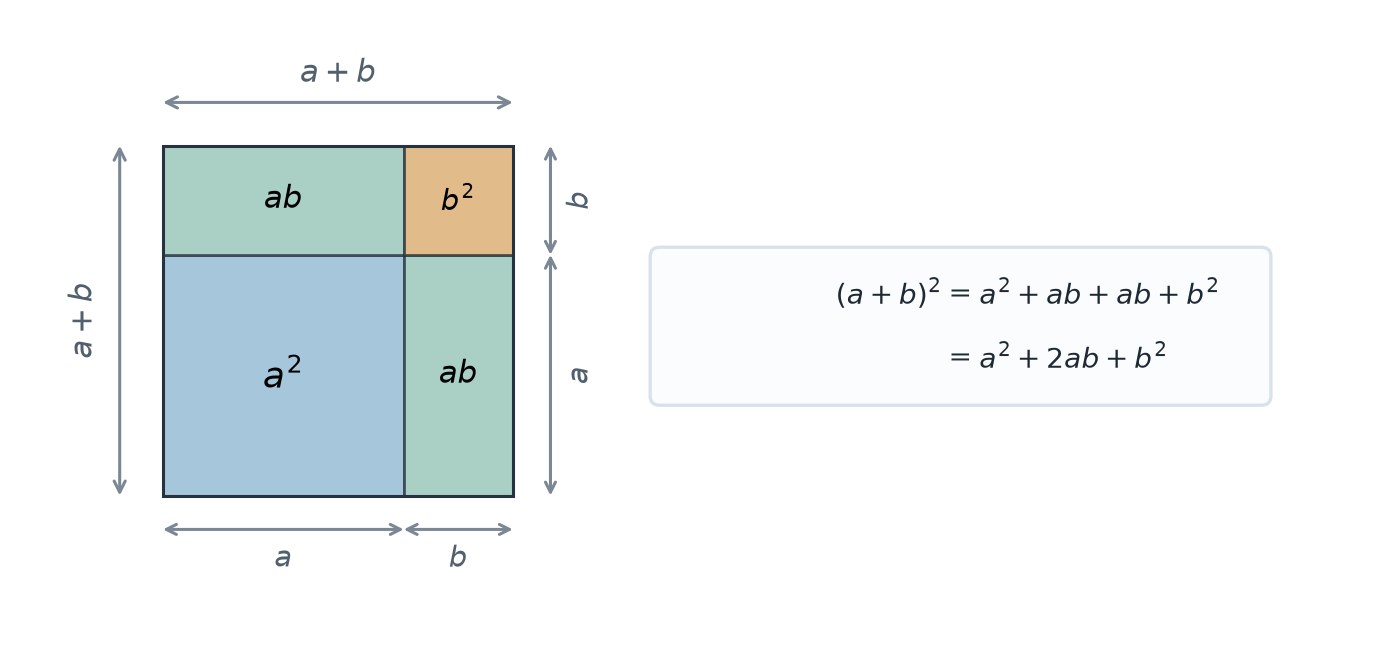
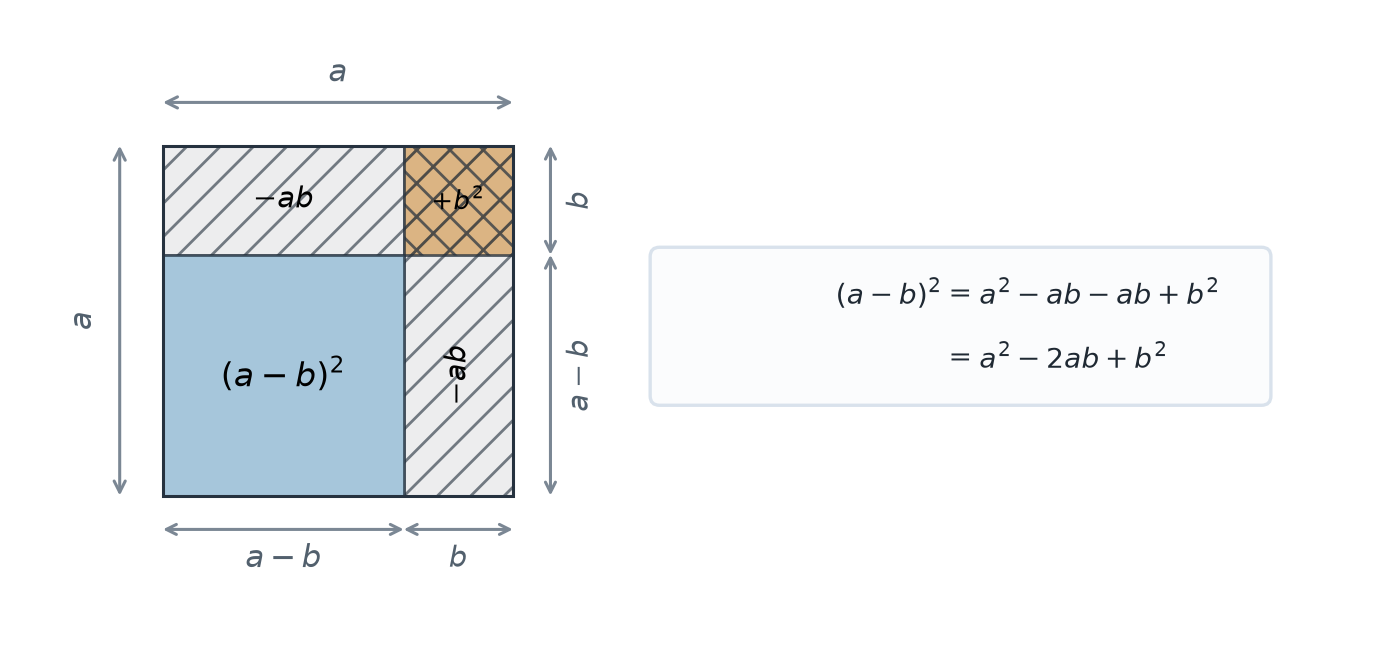
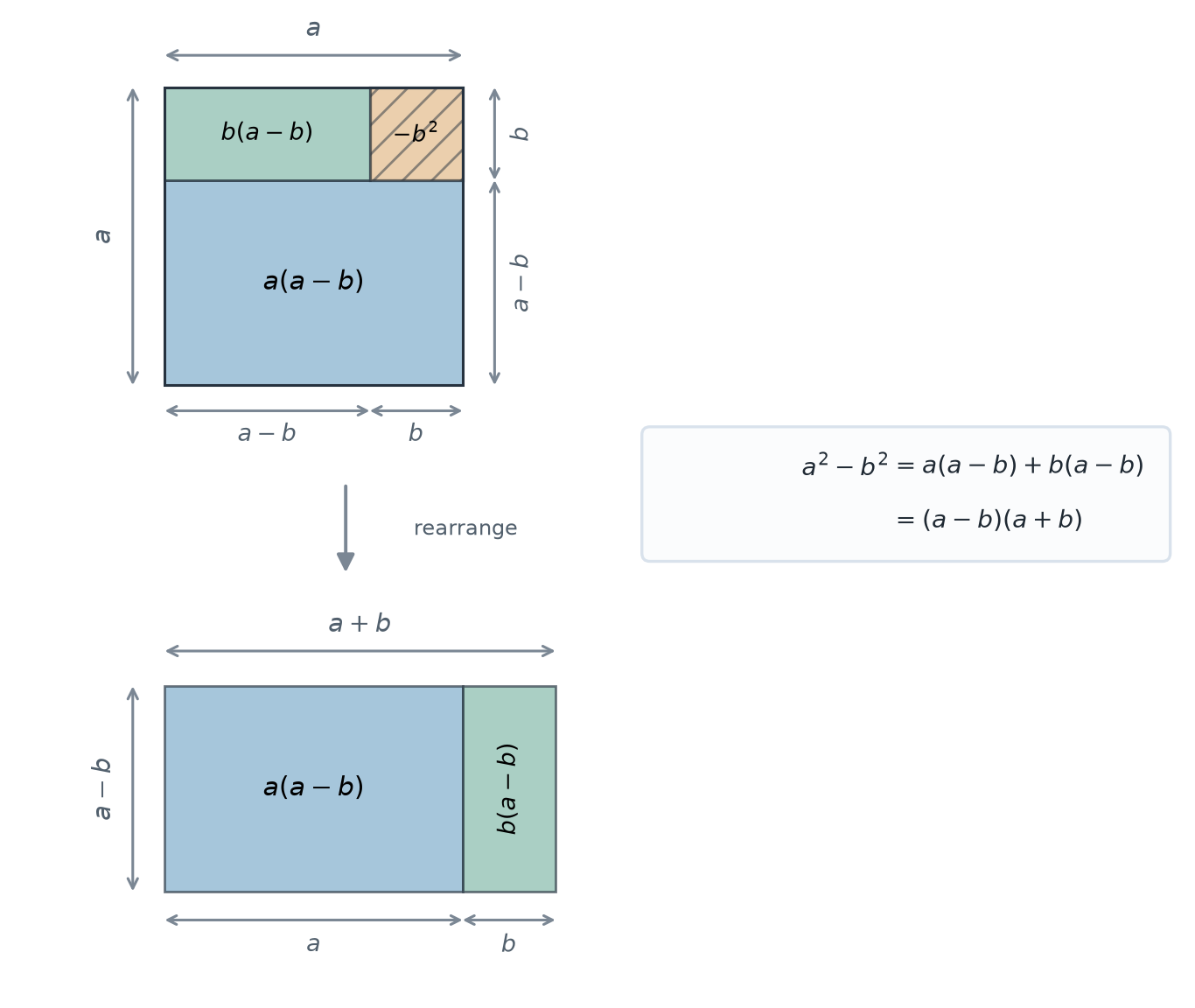
The following figures give area interpretations of the identities in the table. Each figure compares two ways of describing the same area: one from the side lengths of a whole shape, and one from the smaller regions into which the shape is divided. The equation box in each figure records the corresponding algebraic identity. The area pictures assume positive lengths; for the identities involving , assume . The algebraic identities themselves remain valid more generally.
For the square of a sum, split both side lengths of an square into the parts and . This partitions the square into one region, two rectangles, and one region.
For the square of a difference, start with an square and keep the blue square. The two hatched strips represent subtracted areas; their overlap is the corner, which must be added back once.
For the difference of squares, start with an square and remove a square. The remaining area can be split into two rectangles, then rearranged into a single rectangle with side lengths and .
These identities are useful both for expanding expressions and for recognizing factored forms. The same patterns will be used again in Chapter 6 when factoring polynomials.