Chapter 1: Sets and Number Sets
Mathematics is fundamentally about studying patterns, structures, quantities, and logical reasoning. In this context, set theory is a part of the foundational language of mathematics, providing an important framework for clearly describing and discussing collections of objects. Understanding sets and their notation is crucial as they form the basis for more complex mathematical structures and reasoning.
Set Basics
Definition of a Set
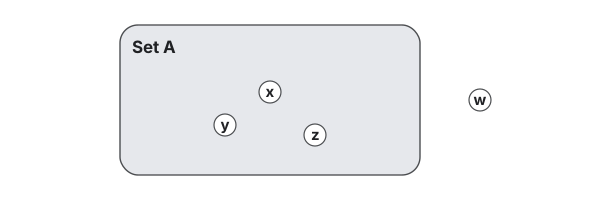
A set is a well-defined collection of distinct objects, called elements.
- Notation: Sets are typically written using curly braces and denoted by capital letters from the Latin alphabet, such as .
- Well-defined: The objects inside a set, i.e., its elements, must be well-defined, meaning it is always clear whether something belongs to the set or not.
- Distinct Elements: A set is determined by its distinct elements. Repeating an element in roster form does not create a new element.
- Order Independence: The order of elements in a set does not matter. For example, and represent the same set.
The elements , , and are placeholders and can represent anything — numbers, symbols, objects, or even abstract concepts — as long as they are clearly identifiable.
The following examples illustrate the definition of a set.
Consider the set of vowels in the English alphabet:
This set clearly lists all the vowels, and it is easy to determine whether a given letter is a vowel or not.
For a set to be meaningful, it must be well-defined. This means it must be clear whether any given object is an element of the set or not. For example, the set of vowels in the word "radio" is well-defined and can be written as:
Similarly, the "set of all days last year with temperatures below C" is well-defined because it is based on objective, measurable data. However, the "set of all cold days last year" is not well-defined because the term "cold" is subjective and can vary from person to person.
The set of vowels in the English alphabet is:
The same set may also be written with a repeated entry:
This notation is valid, but the repetition is redundant. Both rosters describe exactly the same set because each distinct vowel occurs in both. It is therefore clearer to list each element only once.
Consider two sets containing the vowels in the English alphabet:
These two sets are identical because they contain the same elements, regardless of the order in which the elements are listed. Thus:
This example illustrates the concept of order independence in sets, where the arrangement of elements does not define the uniqueness of a set.
The empty set is the unique set that contains no elements. It is denoted by or simply .
Even though it has no elements, it plays a key role in set theory, similar to how plays a key role in arithmetic.
Common Number Sets
The standard number sets used throughout this book are summarized below.
Table 1.1. Common number sets and their standard notation.
| Symbol | Name | Description | Examples |
|---|---|---|---|
| Natural numbers | The counting numbers. | ||
| Natural numbers with zero | The counting numbers together with . | ||
| Integers | The natural numbers, their negatives, and zero. | ||
| Rational numbers | Numbers of the form , where and . | ||
| Real numbers | Numbers represented by points on the number line. | ||
| Irrational numbers | Real numbers that are not rational. | ||
| Complex numbers | Numbers of the form , where and . |
The symbol is used in this book for the irrational numbers. This notation is convenient but not universal. Chapter 2 relates to the rational and real numbers using the set difference operation.
Let be a real number.
Positive number. The number is positive if .
Negative number. The number is negative if .
Non-negative number. The number is non-negative if .
Thus, is neither positive nor negative, but it is non-negative.
An inequality written as a subscript restricts a number set to the elements satisfying that condition. For example,
is the set of positive integers, while denotes the set of positive real numbers—that is, all real numbers greater than .
The same pattern gives notation such as for the non-negative real numbers and for the negative integers.
The subscript in is a related conventional notation indicating that is included with the natural numbers. Explicit inequality subscripts are useful because they state the restriction directly.
Finite set. A set is finite if it has exactly elements for some non-negative integer . For , its distinct elements can be listed completely and without repetition as
For , the set is the empty set. Thus, the empty set is finite because it has elements.
Infinite set. A set is infinite if it is not finite. This means that no finite list contains all of its elements.
Representing Sets
Sets can be described using several notations. The most useful choice depends on whether the elements can be listed conveniently or are better described by a condition or an interval. The most common forms are introduced below.
Verbal Description
A verbal description uses ordinary language to define a set by explaining its elements or properties. This approach is particularly useful for introducing abstract or unfamiliar sets in an intuitive way or for providing context before formalizing the set with mathematical notation.
Here are a few sets described only in words, before translating them into symbols:
- "The set of vowels in the English alphabet."
- "The set of non-negative integers."
- "The set of non-negative integers strictly smaller than 6."
Roster Form
Roster form explicitly lists all elements of a set enclosed in curly braces . This notation is particularly useful for finite sets or infinite sets with clear, recognizable patterns.
The same ideas can be written in roster form by listing their elements explicitly:
-
The set of vowels in the English alphabet:
-
The set of non-negative integers:
-
The set of non-negative integers strictly smaller than 6:
Note: The ellipsis () indicates that the pattern continues indefinitely.
Set-Builder Notation
Set-builder notation provides a precise and compact way to define a set by specifying the properties that its elements must satisfy. The notation takes one of two equivalent forms:
Both forms are read as "the set of all such that the given condition holds".
Here, the symbol represents a generic element of the set, i.e., it does not refer to any particular element but serves as a placeholder for all possible elements that satisfy the condition. The vertical bar () or colon () functions as a divider between the variable and the rule that determines which elements belong to the set.
For example, the condition might express a numerical restriction such as (meaning is strictly greater than zero), a combined relationship like (meaning lies strictly between zero and ten), or a membership rule such as (meaning is an element of the set ). In each case, the notation highlights the defining property rather than listing individual elements.
Because of this, set-builder notation is preferred when working with infinite sets, intervals of real numbers, or sets defined by more complex conditions.
The same examples can also be written by stating the rule an element must satisfy:
-
The set of vowels in the English alphabet:
-
The set of non-negative integers:
-
The set of non-negative integers strictly smaller than 6:
Interval Notation
The real numbers can be visualized geometrically as an infinite line, where each point corresponds to a real number. Intervals are contiguous segments of this line, representing subsets of .

Interval notation describes intervals concisely. Brackets indicate included endpoints, while parentheses indicate excluded endpoints.
Below is a summary of how interval notation corresponds to sets of real numbers together with their corresponding set-builder notation.
Table 1.2. Common interval notation and equivalent set-builder descriptions.
| Set | Interval Notation | Set-Builder Notation | Illustration |
|---|---|---|---|
| All real numbers | |||
| Open interval | |||
| Closed interval | |||
| Infinite to the right | |||
| Infinite to the right | |||
| Infinite to the left | |||
| Infinite to the left | |||
| Half-open (left open) | |||
| Half-open (right open) |
Understanding how elements relate to sets is fundamental, both when defining a single set and when comparing several sets. The next section introduces the corresponding notation.
Here are common intervals written both in interval notation and set-builder notation:
-
Real numbers strictly between and :
-
Real numbers between and , including both endpoints:
-
Real numbers greater than :
-
Real numbers less than or equal to :
Set Membership
Set membership describes the fundamental relationship between elements and a set. This relationship is crucial for defining and understanding the contents of sets.
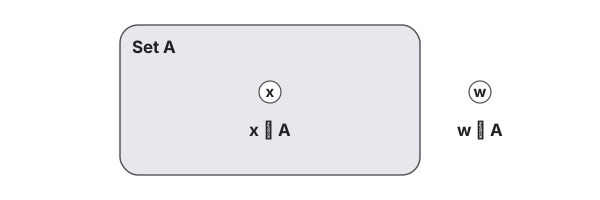
Let be an element and a set. The notation means that is an element, or member, of . If an element is not in , the notation is .
The following examples illustrate how the symbols (is an element of) and (is not an element of) describe whether a value belongs to a particular set.
-
The element belongs to the set because it appears among its members:
-
The element does not belong to the set because it is not included among its elements:
-
The number is a real number, so it belongs to the set of all real numbers:
-
In this case, the elements of the outer set are themselves sets, so is one of its members:
-
The number alone is not a member, because the set only contains sets as elements:
-
The fraction (equal to ) is in the interval because :
-
The number is not in this interval because it is not positive:
This binary relationship, where each element either belongs to a set or does not, precisely defines a set’s contents and forms the basis for defining equality and more advanced set relations.
Two sets and are equal, denoted , if they contain exactly the same elements. This means every element of is in , and every element of is in .
Equivalently, checking equality means verifying membership in both directions.
Cardinality
The cardinality of a set , written , indicates the number of elements in . In other words, the cardinality is the size of .
Countably infinite set. An infinite set is countably infinite if its elements can be listed without repetition in an endless sequence:
so that every element of the set appears exactly once in the list. For example, is countably infinite.
Uncountably infinite set. A set is uncountably infinite if it is infinite, but its elements cannot be completely listed in any sequence. For example, is uncountably infinite.
The following examples show how cardinality records the size of finite, countably infinite, uncountably infinite, and empty sets.
- If , then . This means that is a finite set and has five distinct elements.
- If , then . This means that is a finite set and has six distinct elements.
- If , then (aleph-null, the cardinality of any countably infinite set). This means that is countably infinite, i.e., its elements can be listed one by one in an endless sequence (first 1, then 2, then 3, and so on).
- If , then (the cardinality of the continuum). This means that is uncountably infinite: its elements cannot be listed one by one in a sequence.
- If , then . The empty set contains no elements, so its cardinality is zero.
Subsets & Proper Subsets
Subsets and proper subsets describe the relationship between sets in terms of their elements.
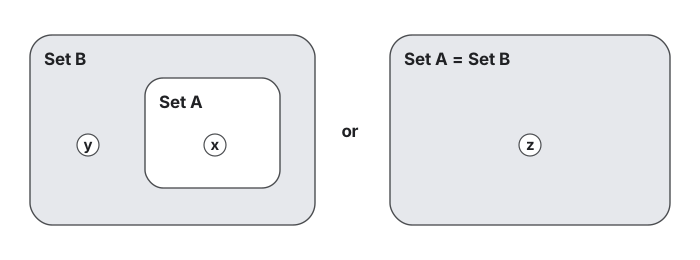
Let and be sets. The set is a subset of if and only if every element of is an element of . This relationship is written .
The following examples compare sets by checking whether every element of one set appears in the other.
-
Let and . Since both sets contain the same elements: Therefore, and are equal sets, and each is a subset of the other.
-
Let and . The empty set contains no elements, so it is a subset of every set:
-
Let and . Every element of is in , so: Since , is also a proper subset, although it can first be identified as a subset.
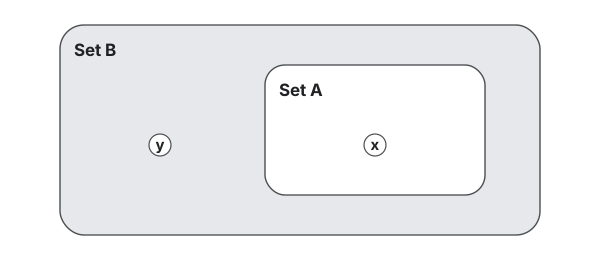
If is a subset of , but is not equal to , then is called a proper subset of . This relationship is written
In this book, is reserved for proper subsets, while allows equality. The distinction is about containment, not necessarily cardinality.
If a subset contains all the elements of the original set, it is still considered a subset, but not a proper one.
The following examples emphasize the extra requirement for a proper subset: the larger set must contain at least one additional element.
-
Let and . Every element of is in , but has one additional element. Therefore: That is, is a proper subset of .
-
Similarly, let and . All elements of are contained in , but has additional elements ( and ). Hence: That is, again, is a proper subset of .
-
The natural numbers form a proper subset of the integers: Both sets are countably infinite, so a proper subset need not have smaller cardinality when the sets are infinite.
These examples show that every element of a proper subset belongs to the larger set, but the larger set has at least one element that is not in the proper subset. A proper subset is strictly smaller by inclusion, although it need not have a smaller cardinality when the sets are infinite.
Number Set Hierarchy
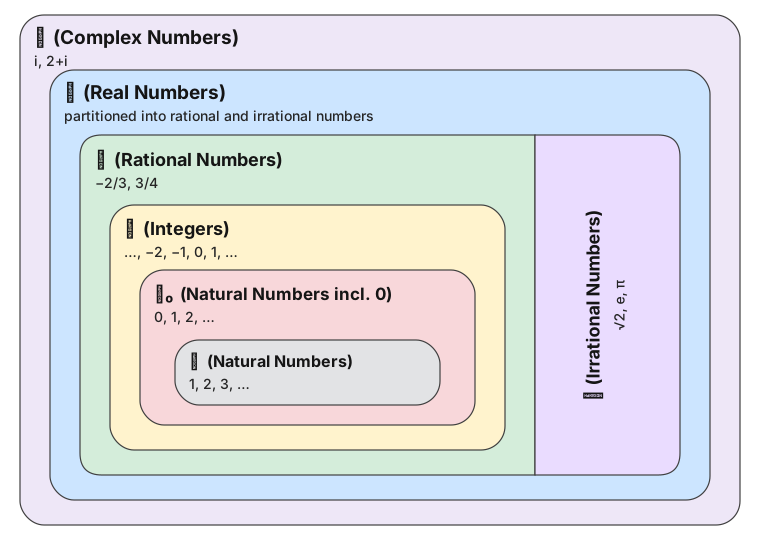
With subset notation established, the common number sets can be arranged according to how they fit inside one another. These number sets form a natural hierarchy: smaller number systems are contained within larger ones.
For example, every natural number is also an integer, every integer is also a rational number, and every rational number is also a real number. The diagram below illustrates this nesting.
The hierarchy can be expressed symbolically as:
The irrational numbers also lie inside the real numbers, but they are not part of the rational numbers. In symbols:
This hierarchy clarifies how different number systems extend one another and expand the kinds of quantities that can be represented.